


For online gaming operators, the threat of DDoS attacks goes beyond temporary website inaccessibility. Such attacks can directly affect player logins, game connections, and the overall service experience. The challenge becomes even greater when attackers move beyond overwhelming services with massive traffic volumes and instead use numerous distributed sources to establish persistent connections.
One gaming company experienced a large-scale L7 slow-rate DDoS attack that generated approximately 40 million malicious connections over two days. Faced with continuous and highly distributed attack traffic, how did SkyCloud respond by rapidly adjusting its defense architecture and blocking malicious requests without affecting legitimate player connections, ensuring uninterrupted gaming services?
Keeping Gaming Services Online Requires More Than Blocking High-Volume Attacks
For online gaming operators, stable connectivity directly affects player experience and service operations. When a website or gaming platform comes under a DDoS attack, attackers do not necessarily rely on sudden traffic spikes to overwhelm the service. They may also use numerous distributed sources to establish persistent connections at low frequencies over extended periods, blending malicious traffic with legitimate player requests and making detection and mitigation more difficult.
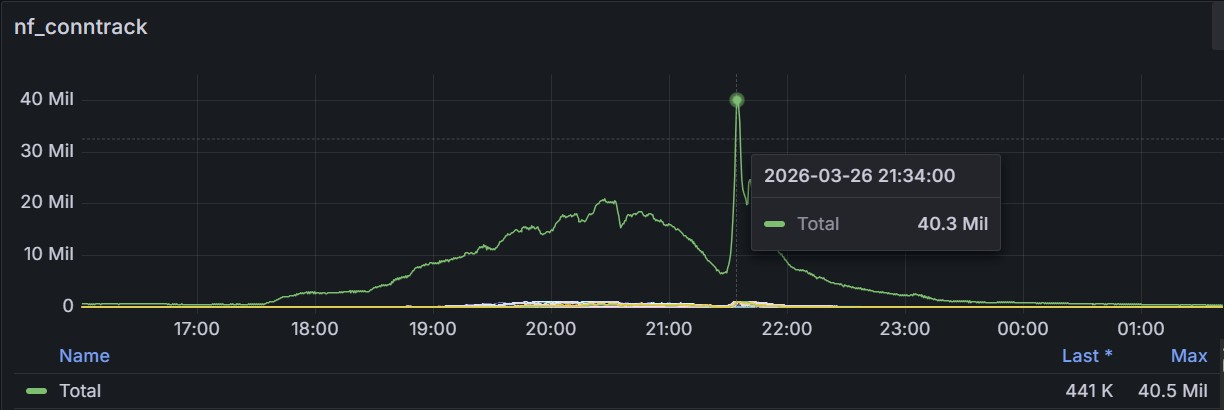
One gaming company experienced a suspected targeted L7 DDoS attack. During the incident, the number of malicious connections reached approximately 40 million, with the attack lasting for two days. Faced with a massive volume of highly distributed, slow-rate connections, traditional traffic-based defense mechanisms alone were insufficient to effectively distinguish legitimate players from malicious requests.
Referred by a system integrator (SI), the company adopted SkyCloud's CDN and cloud-based WAF defense architecture. During the ongoing attack, SkyCloud rapidly expanded defense resources and adjusted WAF rules based on attack characteristics, successfully blocking malicious connections and ensuring uninterrupted gaming services.
Attack Challenges: Distributed Sources and Low-Frequency Requests Make Detection More Difficult
What made this attack particularly challenging was not an extremely high volume of requests from a single source, but the highly distributed nature of the attack. A botnet consisting of numerous infected devices simultaneously established connections to the gaming service.
Unlike high-speed attacks that send massive numbers of requests within a short period, slow-rate attacks deliberately reduce the request frequency from each individual source, making each source appear more like a legitimate user. When numerous sources launch attacks in a similar manner at the same time, they can generate highly distributed malicious traffic.
In this incident, the attack involved approximately 40 million malicious connections at its peak. Both the scale and distribution of the sources significantly increased the difficulty of defense. For gaming operators, the key challenge is not simply to block traffic, but to stop the attack without disrupting real players who are actively playing the game.
Defense Strategy 1: Cloud-Based WAF for Precise Detection of Malicious Requests
To counter the highly distributed L7 attack, SkyCloud first leveraged its proprietary cloud-based WAF to analyze the connection and request patterns associated with the attack and adjust defense rules according to actual attack behavior.
By inspecting requests at the HTTP/HTTPS layer, the WAF can further identify abnormal requests and distinguish them from legitimate user behavior. This enables malicious connections to be blocked while minimizing the impact on legitimate player traffic.
This highlights the difference between L7 DDoS protection and conventional traffic scrubbing. When both attack traffic and legitimate user traffic enter the system as seemingly valid application-layer requests, the defense system must have more sophisticated application-layer analysis and rule-adjustment capabilities.
Defense Strategy 2: Flexible CDN Node Scaling to Rapidly Distribute Attack Traffic
In addition to adjusting WAF rules, another key factor in the defense strategy was SkyCloud's ability to flexibly scale CDN nodes. As attack traffic continued to increase, SkyCloud could rapidly deploy additional CDN nodes using public cloud and data center resources based on actual requirements, significantly expanding overall defense capacity within a short period.
The attack lasted for two days. During this period, the defense team rapidly deployed hundreds of CDN nodes, distributing traffic across multiple nodes through a distributed architecture. Combined with WAF-based application-layer request detection and mitigation, this approach reduced the load on individual nodes.
This approach—combining flexible scaling, traffic distribution, and application-layer protection—allows the defense architecture to adapt dynamically to changing attack conditions rather than relying solely on fixed hardware or existing defense capacity.
Defense Results: 40 Million Malicious Connections, Gaming Services Remain Operational
The attack lasted approximately two days and involved up to around 40 million malicious connections. SkyCloud accurately identified attack patterns through its cloud-based WAF and combined this with flexible CDN node scaling and traffic distribution to effectively block malicious connections.
Throughout the attack, gaming services remained online despite the large volume of malicious connections, allowing legitimate players to maintain stable connections and enjoy an uninterrupted gaming experience.
For gaming operators, the value of DDoS protection is not measured solely by how much attack traffic is blocked. More importantly, it lies in the ability to rapidly adapt the defense architecture in response to sudden, highly distributed attacks while maintaining a balance between cybersecurity protection and service availability.
Conclusion: Flexible Defense Architectures Are Essential Against Extreme Attacks
This case demonstrates that the threat posed by L7 slow-rate DDoS attacks is no longer limited to overwhelming services with massive traffic volumes. Instead, attackers use large numbers of distributed, low-frequency connections to make it increasingly difficult to distinguish malicious traffic from legitimate user requests.
Defending against these attacks requires not only application-layer analysis and WAF protection, but also a flexible architecture that can rapidly adapt to changing attack scales.
Through a multi-layered defense architecture combining CDN Traffic Distribution × Cloud-Based WAF Application-Layer Protection × Flexible Node Scaling, SkyCloud helps gaming operators maintain service stability during prolonged, highly distributed L7 DDoS attacks, ensuring that gaming services remain operational throughout an attack.
Related Articles:
• A Leading Taiwanese Department Store Adopts a Localized DDoS Protection Solution to Ensure Stable, Uninterrupted Website Services
• A Leading Taiwanese Publicly Listed Company Deploys SkyCloud CDN, Improving Cross-Border Website Speed by 90% and Strengthening Cybersecurity Protection
• A Major Financial Institution Adopts SkyCloud CDN and Anti-DDoS Solutions, Balancing Protection Performance, Cost Efficiency, and Local Technical Support
 Experience fast, secure, and reliable service.