


In the digital age, website stability is a crucial operational standard for enterprises. DDoS attacks are a common and destructive type of cyberattack; if businesses do not properly defend against DDoS, it can lead to significant losses!
The principle of a DDoS attack is that hackers initiate a massive number of requests and connections, flooding the target website server with a high volume of abnormal traffic and pressure. This causes the target server to lose its normal capacity and processing power, leading to resource exhaustion and the interruption of website and online services.
Table of Contents
➤ What is DDoS?
➤ DDoS Attack Principle: How DDoS Cripples Websites
➤ Common DDoS Attack Methods
➤ How to Defend Against DDoS Attacks
What is DDoS?
DDoS, or Distributed Denial-Of-Service, is a malicious network attack method evolved from the earlier DoS (Denial-Of-Service) attack.
In early DoS attacks, abnormal traffic usually came from a single source, representing a one-to-one attack from system to system.
In contrast, DDoS involves two or more sources of abnormal traffic. Attackers control multiple devices to launch a DDoS attack, invading the server with malicious traffic from numerous origins. The speed of a DDoS attack is extremely fast, preventing normal users from successfully connecting to the website.
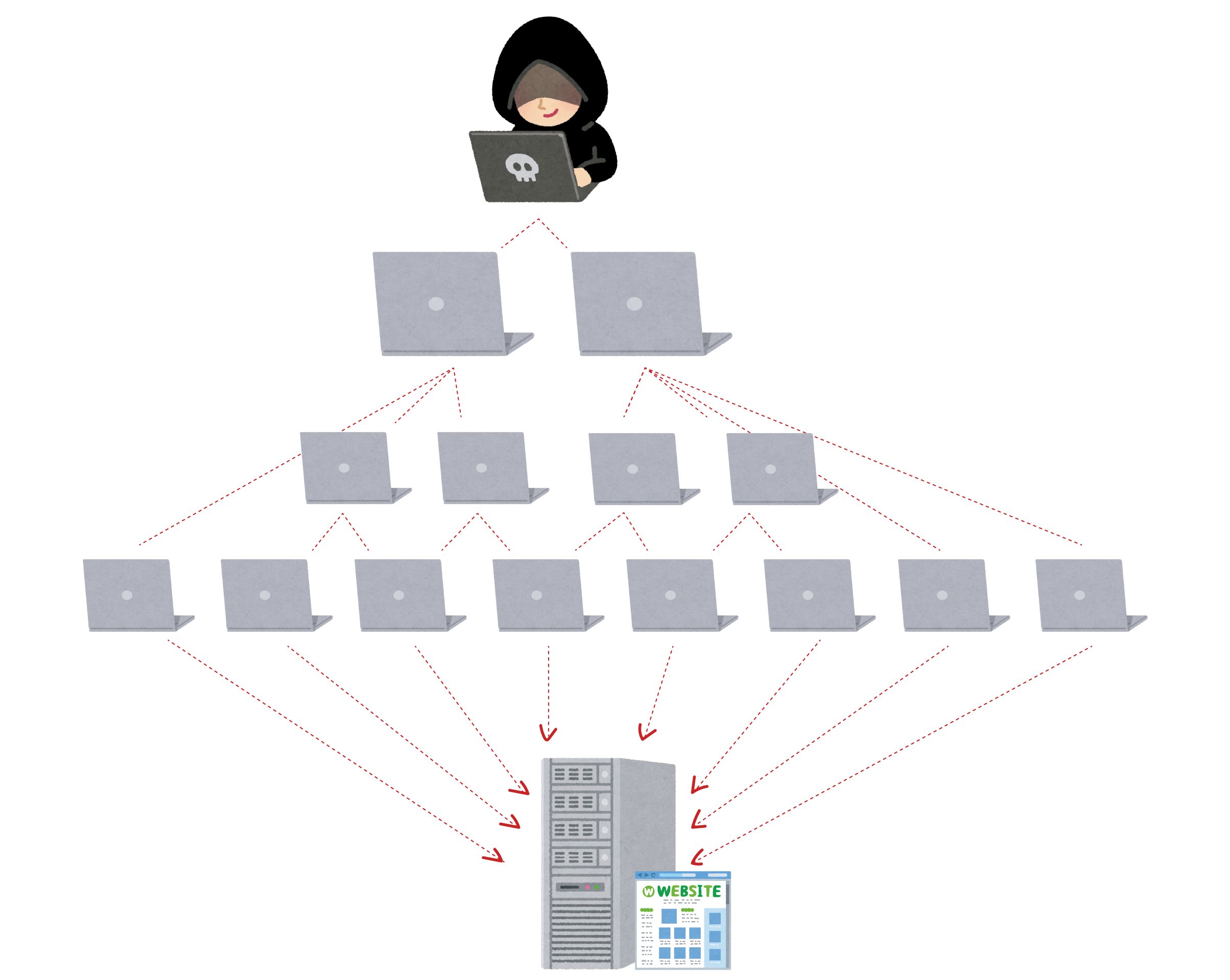
▲ Diagram of a DDoS attack on a website server
DDoS Attack Principle: How DDoS Cripples Websites
The principle of DDoS is to use "massive amounts of abnormal traffic" to simultaneously send requests to a specific website or server. This rapidly exhausts the target's bandwidth and processing resources, causing network congestion, resource depletion, or complete paralysis, resulting in slowed or non-functional online services.
The flood of malicious DDoS traffic prevents users from connecting to websites and servers, also stopping website owners and merchants from providing services to customers. A DDoS scenario is like a concert ticket website suddenly being swamped by a massive crowd; the website cannot handle the load, causing many users to be unable to access the service.
This malicious DDoS traffic comes from "Botnets" distributed worldwide. These botnets consist of devices controlled by hackers, such as infected computers, IoT devices, or servers. Industries such as finance, cryptocurrency, gaming, telecommunications, and internet communications are frequent targets of hacker DDoS attacks.
Common DDoS Attack Methods
Most DDoS attack methods involve sending a large number of invalid requests to consume massive resources of websites and servers. DDoS causes the website to fail to provide services, leading to operational disruption. Some hackers even use DDoS attacks for extortion, demanding a ransom to stop the attack.
【What are the Common Types of DDoS Attacks?】
SYN Flood Attack
Principle:
The attacker sends a large number of SYN (synchronize) packets during the TCP three-way handshake but does not complete the final step, exhausting the server's resources.Purpose:
To reach the limit of the server's semi-open connection table, preventing legitimate users from establishing new connections.
ACK Flood Attack
Principle:
The attacker forges a large number of ACK (acknowledgment) packets and continuously sends them to the target server.Purpose:
To occupy server resources and reduce its ability to process legitimate requests.
RST Flood Attack
Principle:
By sending a massive number of RST packets, the attacker interrupts the TCP connections between the server and users.Purpose:
To interfere with normal data transmission and damage the user experience.
Push+Ack Attack
Principle:
The attacker continuously sends packets with PUSH and ACK flags to the target server.Purpose:
To drain server resources, leading to a significant drop in operational efficiency.
TCP Connection Exhaustion Attack
Principle:
The attacker completes the normal TCP three-way handshake but keeps these connections idle without transmitting data.Purpose:
To max out the server's concurrent connection limit, blocking new users' connection requests.
Slowloris Attack
Principle:
The attacker establishes multiple TCP connections and sends HTTP requests at an extremely slow rate to keep the connections open.Purpose:
To occupy server resources for a long time, preventing other users from connecting or submitting requests.
Zero-Day Exploits
Principle:
Exploiting unknown security vulnerabilities within the server's TCP protocol.Purpose:
To bypass existing security protections and cause direct damage to the server.
Teardrop Attack
Principle:
Exploiting the way the TCP protocol reassembles data by sending overlapping or garbled packets.Purpose:
When the system attempts to reassemble the damaged packets, errors occur, leading to a system crash.
UDP Flood Attack
Principle:
Exploiting protocol vulnerabilities to generate a massive volume of UDP packets.Purpose:
To create a DDoS attack that occupies system bandwidth, preventing users from receiving or sending necessary UDP packets.
ICMP Flood Attack / Ping Flood Attack
Principle:
Forging a large number of ICMP messages to occupy network bandwidth or server resources.Purpose:
The surge in network traffic caused by massive ICMP messages prevents users from connecting or results in slow transmission.
DNS Amplification Attack (Volumetric Attack)
Principle:
Forging the victim's IP to send many requests to DNS servers; once the servers resolve these, they send the responses to the victim's device.Purpose:
The victim's system or device is overwhelmed by a flood of responses, exhausting bandwidth and resources.
CC Attack (Challenge Collapsar Attack)
Principle:
Sending a massive number of response requests to the server, usually targeting web applications (apps) like online banking, email, or e-commerce platforms.Purpose:
The server cannot respond in time, exhausting CPU resources and causing service downtime.
Distributed HTTP Flood Attack
Principle:
Sending a massive volume of requests to the server via websites, using multiple connections or submitting numerous forms to cripple the site.Purpose:
The server is overwhelmed, leading to CPU exhaustion and service suspension.
Slow Attack
Principle:
Establishing many very slow connections with the server.Purpose:
When all slow connections simultaneously transmit data or requests, server response time increases, eventually depleting all resources.
How to Defend Against DDoS Attacks
DDoS attacks often burst instantly, crippling target systems in a short time and preventing users from accessing online services. So, how can you defend against them?
Defending against DDoS attacks cannot be achieved with a single tool or technique; instead, a multi-layered defense architecture is required to reduce risk and loss.
【Establish Abnormal Traffic Monitoring Mechanisms】
Enterprise websites can proactively monitor incoming traffic to detect DDoS attacks early.
By installing abnormal traffic and connection monitoring tools, you can oversee server traffic and connection statuses. When DDoS traffic is detected, the system alerts administrators.
Some monitoring tools even offer proactive defense measures, automatically activating offloading and traffic scrubbing during an attack to shorten response time and provide comprehensive protection.
【Use CDN Nodes for Traffic Offloading】
Websites can utilize Content Delivery Networks (CDN) to place cached content across multiple global nodes. User requests are directed to the nearest node, reducing pressure on the origin server. During a DDoS attack, the CDN absorbs most of the traffic, maintaining stability for the origin server.
【Deploy Firewalls】
A Web Application Firewall (WAF) can monitor HTTP traffic, blocking malicious and suspicious traffic (including DDoS, bots, crawlers, and repetitive requests) to protect the website from attacks.
【Reserve Extra Bandwidth and Backup Servers】
Since DDoS attacks cause sudden surges in traffic that can crash servers, enterprises should prepare spare bandwidth and server resources. This allows for flexible resource deployment during an attack to maintain normal service.
【Filter Abnormal Traffic and Build Traffic Scrubbing Centers】
Businesses can set up traffic scrubbing centers to filter abnormal traffic. When an attack occurs, routing can be switched to direct suspected malicious traffic to the scrubbing center for analysis. Only verified safe traffic is then returned to the server.
【Use DDoS Protection Service Providers】
Providers like Cloudflare, AWS Shield, and SkyCloud Computing can filter Tbps-level (Terabits per second) attack traffic, which is critical for countering complex attacks.
【Implement Rate Limiting】
To prevent resources from being exhausted by a few malicious users, it is recommended to limit the amount of resources each user can consume. Rate limiting prevents malicious users from sending excessive requests, reducing server resource consumption and defending against DoS.
Summary
DDoS attacks are among the most common, rapid, and destructive cyberattacks today. Both enterprise and personal websites can become targets for hackers.
Understanding the principles and methods of DDoS, combined with a multi-layered defense strategy and cloud resources, can significantly lower attack risks and ensure the stability of websites and online services.
SkyCloud Computing's DDoS/CC defense services provide powerful security for your network business. Click the button below to contact us and experience our professional defense capabilities.
'/%3e%3cdefs%3e%3clinearGradient%20id='paint0_linear_372_3728'%20x1='19.2966'%20y1='17.8555'%20x2='4.40396'%20y2='14.991'%20gradientUnits='userSpaceOnUse'%3e%3cstop%20stop-color='%2336BCD4'/%3e%3cstop%20offset='1'%20stop-color='%2362E0B9'/%3e%3c/linearGradient%3e%3c/defs%3e%3c/svg%3e) Experience fast, secure, and reliable service.
Experience fast, secure, and reliable service.


'/%3e%3cpath%20d='M38.0476%2033.4361C38.563%2033.9451%2039.3985%2033.9451%2039.914%2033.4361C40.4294%2032.927%2040.4294%2032.1018%2039.914%2031.5927L28.4218%2020.2421L16.9296%2031.5927C16.4141%2032.1018%2016.4141%2032.927%2016.9296%2033.4361C17.445%2033.9451%2018.2805%2033.9451%2018.7959%2033.4361L28.4218%2023.9289L38.0476%2033.4361Z'%20fill='%23222222'/%3e%3cdefs%3e%3clinearGradient%20id='paint0_linear_1305_5534'%20x1='53.5'%20y1='53.5'%20x2='-6.00852'%20y2='43.6145'%20gradientUnits='userSpaceOnUse'%3e%3cstop%20stop-color='%2336BCD4'/%3e%3cstop%20offset='1'%20stop-color='%2362E0B9'/%3e%3c/linearGradient%3e%3c/defs%3e%3c/svg%3e)